
Rethinking Cultural Keystone Practices: Conflict Resolution Practices as Examples of Salience and Well-Being
Abstract
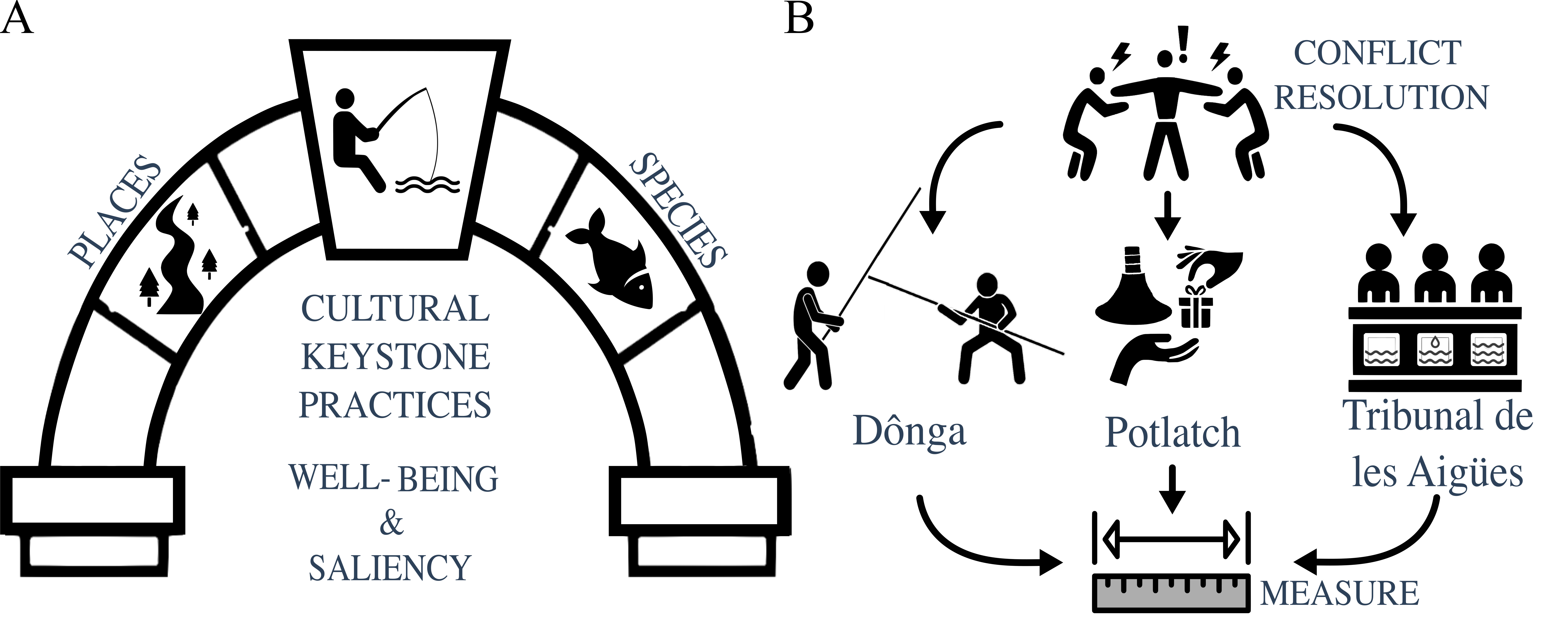
We explore and expand on the concept of Cultural Keystone Practices as an extension of the concept of Cultural Keystone Species and Places. These concepts have helped raise awareness of traditional human-environment interactions by focusing on community well-being and salience. We discuss several keystone-related terms and link them as interdependent for well-being, where salience itself might fall within one keystone concept or another. We focus on three illustrative examples of Cultural Keystone Practices (tribunal de les aigües, Potlatch and dônga) which share conflict resolution as a well-being function. In these three cases, the salience resides in the practice itself, rather than in a particular place or species. Moreover, since the societies that host these practices perceive them as traditions that are not easily substituted with other ‘functional’ equivalents, we can consider them as keystones. Furthermore, we emphasize the need for an assessment strategy for these practices and highlight the limitations of other approaches for the direct and indirect protection of cultural practices, such as UNESCO’s Intangible Cultural Heritage (ICH). Cultural Keystone Practices can be a key enabler for people’s recognition of culture as essential for well-being. A standardized, cross-cultural, community-driven measurement of Cultural Keystone Practices has the potential to serve as a foundation for evaluating the risk of cultural loss associated with significant cultural practices, as well as the consequences of such loss, across diverse contexts.
References
Aguilar, L. K., and C. E. Webb. 2024. Keystones for Conservation: Diversity, Wellbeing, Coexistence. Biological Conservation 291:110464. DOI:10.1016/j.biocon.2024.110464.
Berkes, F., J. Colding, and C. Folke. 2000. Rediscovery of Traditional Ecological Knowledge as Adaptive Management. Ecological Applications 10:1251–1262. DOI:10.1890/1051-0761(2000)010[1251:ROTEKA]2.0.CO;2.
Brosi, B. J., M. J. Balick, R. Wolkow, R. Lee, M. Kostka, W. Raynor, R. Gallen, A. Raynor, P. Raynor, and D. Lee Ling. 2007. Cultural Erosion and Biodiversity: Canoe-Making Knowledge in Pohnpei, Micronesia. Conservation Biology 21:875–879. DOI:10.1111/j.1523-1739.2007.00654.x.
Cuerrier, A., C. Clark, and C. H. Norton. 2019. Inuit Plant Use in the Eastern Subarctic: Comparative Ethnobotany in Kangiqsualujjuaq, Nunavik, and in Nain, Nunatsiavut. Botany 97:271–282. DOI:10.1139/cjb-2018-0195.
Cuerrier, A., N. J. Turner, T. C. Gomes, A. Garibaldi, and A. Downing. 2015. Cultural Keystone Places: Conservation and Restoration in Cultural Landscapes. Journal of Ethnobiology 35:427–448. DOI:10.2993/0278-0771-35.3.427.
Davidson, S. F., and R. Davidson. 2018. Potlatch as Pedagogy: Learning through Ceremony. Portage and Main Press, Winnipeg, Canada.
Ellen, R. 2006. Local Knowledge and Management of Sago Palm (Metroxylon sagu Rottboell) Diversity in South Central Seram, Maluku, Eastern Indonesia. Journal of Ethnobiology 26:258–298. DOI:10.2993/0278-0771(2006)26[258:LKAMOS]2.0.CO;2.
Food and Agriculture Organization of the United Nations. 2024. Historical Waterscape of l’Horta de València. Available at: https://www.fao.org/giahs/giahsaroundtheworld/designated-sites/europe-and-central-asia/historical-waterscape-of-lhorta-de-valencia/en/. Accessed on October 3, 2024.
Garibaldi, A., and N. Turner. 2004. Cultural Keystone Species: Implications for Ecological Conservation and Restoration. Ecology and Society 9. DOI:10.5751/ES-00669-090301.
Guinot, E., and F. Esquilache. 2017. Not Only Peasants: The Myth of Continuity in the Irrigation Communities of Valencia, Spain, in the Medieval and Early Modern Periods. Continuity and Change 32:129–156. DOI:10.1017/S0268416017000194.
Hunt, D. 2005. We Are All Different, Still Living under the Same Culture: A Kwakwaka’wakw Perspective on Dispute Resolution and Resolution Building. Master Thesis, Malaspina University College, Faculty of Human and Social Development Institute for Dispute Resolution, Nanaimo, Canada.
Kimmerer, R. 2013. Braiding Sweetgrass: Indigenous Wisdom, Scientific Knowledge and the Teachings of Plants. Milkweed Editions, Minneapolis.
Kuhnlein, H., and N. Turner. 2020. Traditional Plant Foods of Canadian Indigenous Peoples: Nutrition, Botany and Use. Routledge, London. DOI:10.4324/9781003054689.
LaTosky, S. 2015. Predicaments of Mursi (Mun) Women in Ethiopia’s Changing World. The Journal of Modern African Studies 53:254–255. DOI:10.1017/S0022278X15000269.
LaTosky, S., and O. Olibui. 2023. Performing Dônga. The Restorative Benefits of Ritual Stick Duelling in Mursi (Mun). Antropologia Pubblica 9:115–140. DOI:10.1473/anpub.v9i1.301.
Lepofsky, D., C. G. Armstrong, S. Greening, J. Jackley, J. Carpenter, B. Guernsey, D. Mathews, and N. J. Turner. 2017. Historical Ecology of Cultural Keystone Places of the Northwest Coast. American Anthropologist 119:448–463. DOI:10.1111/aman.12893.
Loo, T. 1992. Dan Cranmer’s Potlatch: Law as Coercion, Symbol, and Rhetoric in British Columbia, 1884–1951. Canadian Historical Review 73:125–165. DOI:10.3138/CHR-073-02-01.
Lucas, J. 2024. UNESCO’s Quest to Save the World’s Intangible Heritage. The New Yorker.
Lundy, B. D., T. L. Collette, and J. T. Downs. 2022. The Effectiveness of Indigenous Conflict Management Strategies in Localized Contexts. Cross-Cultural Research 56:3–28. DOI:10.1177/10693971211051534.
Martínez-Sanchis, I., and M. J. Viñals. 2015. Enhancing The Traditional Mediterranean Irrigation Agroecosystems: A Case Study of The Rivers Túria and Júcar (Valencia, Spain). In Ecosystems and Sustainable Development X, edited by J. L. Miralles i Garcia and C. A. Brebbia, pp. 45–54. WIT Press, Ashurst. DOI:10.2495/ECO150051.
Nwosu, E. O. 2021. Peace and Conflict Resolution as a Strategy for Societal Wellbeing. ESUT Journal of Social Sciences 6.
Paine, R. T. 1969. A Note on Trophic Complexity and Community Stability. American Naturalist 103:91–93.
Platten, S., and T. Henfrey. 2009. The Cultural Keystone Concept: Insights from Ecological Anthropology. Human Ecology 37:491–500. DOI:10.1007/s10745-009-9237-2.
Reyes-García, V., R. Cámara-Leret, B. S. Halpern, C. O’Hara, D. Renard, N. Zafra-Calvo, and S. Díaz. 2023. Biocultural Vulnerability Exposes Threats of Culturally Important Species. Proceedings of the National Academy of Sciences 120:e2217303120. DOI:10.1073/pnas.2217303120.
Shaheen, F. A. 2016. The Art of Glacier Grafting: Innovative Water Harvesting Techniques in Ladakh. IWMI-Tata Water Policy Research Highlight 8. DOI:10568/89600.
Tollefson, K. D. 1995. Potlatching and Political Organization among the Northwest Coast Indians. Ethnology 34:53–73. DOI:10.2307/3773863.
Tsuji, S. R. J., A. M. Zuk, A. Solomon, R. Edwards-Wheesk, F. Ahmed, and L. J. S. Tsuji. 2023. What Is Wellbeing, and What Is Important for Wellbeing? Indigenous Voices from across Canada. International Journal of Environmental Research and Public Health 20:6656. DOI:10.3390/ijerph20176656.
Turner, N. J., I. J. Davidson-Hunt, and M. O’Flaherty. 2003. Living on the Edge: Ecological and Cultural Edges as Sources of Diversity for Social—Ecological Resilience. Human Ecology 31:439–461. DOI:10.1023/A:1025023906459.
Turton, D. 2002. The Same Only Different: War and Duelling as Boundary Marking Rituals in Mursiland, Southwestern Ethiopia. In War and Games, edited by T. J. Cornell and T. B. Allen, pp. 171–192. Boydell Press, Woodbridge/Rochester.
Tuso, H., and M. P. Flaherty, eds. 2016. Creating the Third Force: Indigenous Processes of Peacemaking. Lexington Books, Lanham, MD.
UNESCO. 2024. UNESCO - Tribunales de regantes del Mediterráneo español: el Consejo de Hombres Buenos de la Huerta de Murcia y el Tribunal de las Aguas de la Huerta de Valencia. Available at : https://ich.unesco.org/es/RL/tribunales-de-regantes-del-mediterraneo-espanol-el-consejo-de-hombres-buenos-de-la-huerta-de-murcia-y-el-tribunal-de-las-aguas-de-la-huerta-de-valencia-00171. Accessed on July 2, 2024.
Valdez, L. M., and C. Vivanco. 2021. Tinkuqchaka: A Suspension Bridge over the Upper Pampas River, Ayacucho, Peru. Journal of Anthropological Research 77:208–233. DOI:10.1086/713655.
Vallés-Planells, M., F. Galiana, and I. Díez Torrijos. 2020. Agricultural Abandonment and Resilience in a Mediterranean Periurban Traditional Agroecosystem: A Landscape Approach. Ecology and Society 25:art5. DOI:10.5751/ES-11346-250105.
Wilson, M. 2021. Slow Storytelling and Hybridity: Re-Staging Community Storytelling as a Tool for Co-Thinking. Book 2.0 11:107–123. DOI:10.1386/btwo_00047_1.
Winter, K. B., N. K. Lincoln, and F. Berkes. 2018. The Social-Ecological Keystone Concept: A Quantifiable Metaphor for Understanding the Structure, Function, and Resilience of a Biocultural System. Sustainability 10:3294. DOI:10.3390/su10093294.
Copyright (c) 2025 Andreu Arinyo-i-Prats, Shauna LaTosky, Nancy J. Turner

This work is licensed under a Creative Commons Attribution-NonCommercial 4.0 International License.
Authors who publish with this journal agree to the following terms:
- Authors retain ownership of the copyright for their content and grant Ethnobiology Letters (the “Journal”) and the Society of Ethnobiology right of first publication. Authors and the Journal agree that Ethnobiology Letters will publish the article under the terms of the Creative Commons Attribution-NonCommercial 4.0 International Public License (CC BY-NC 4.0), which permits others to use, distribute, and reproduce the work non-commercially, provided the work's authorship and initial publication in this journal are properly cited.
- Authors are able to enter into separate, additional contractual arrangements for the non-exclusive distribution of the journal's published version of the work (e.g., post it to an institutional repository or publish it in a book), with an acknowledgement of its initial publication in this journal.
For any reuse or redistribution of a work, users must make clear the terms of the Creative Commons Attribution-NonCommercial 4.0 International Public License (CC BY-NC 4.0).
In publishing with Ethnobiology Letters corresponding authors certify that they are authorized by their co-authors to enter into these arrangements. They warrant, on behalf of themselves and their co-authors, that the content is original, has not been formally published, is not under consideration, and does not infringe any existing copyright or any other third party rights. They further warrant that the material contains no matter that is scandalous, obscene, libelous, or otherwise contrary to the law.
Corresponding authors will be given an opportunity to read and correct edited proofs, but if they fail to return such corrections by the date set by the editors, production and publication may proceed without the authors’ approval of the edited proofs.


