
Archaeofaunal Remains, Geography, and the Investigation of Cultural Keystone Places
Abstract
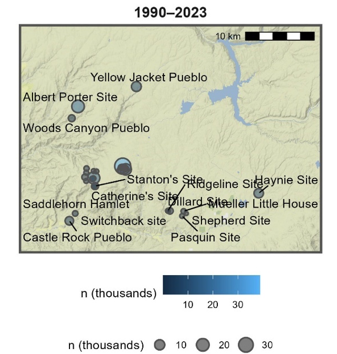
Cultural Keystone Places (CKPs) are areas on the landscape crucial to individual and group identities, especially descendant communities. As such, they are often significant components of Indigenous land claims and cultural continuity. CKPs commonly have deep temporal roots and unclear spatial boundaries, and archaeological investigation is often relied upon to define them. However, relying on archaeological prospection and data to define a CKP can be problematic. The discovery of archaeological material and, by extension, a CKP is a probabilistic endeavor, often constrained by preservation conditions and sampling strategies. While many archaeologists understand that the material record will always be incomplete and that the absence of archaeological materials does not indicate the absence of a CKP, this view is juxtaposed with comparatively simple legal or regulatory understandings of CKPs as areas exclusively defined by either the presence or absence of archaeological materials in places such as British Columbia, Canada, which we discuss in this paper. To frame that discussion, we turn to the archaeological record from a different region; we use a large multisite database from southwestern Colorado—created and curated by the Crow Canyon Archaeological Center—to illustrate the variability in the quality of the archaeological record across the landscape. By modeling the fragmentation and sample size of animal remains, we demonstrate how even systematically collected archaeological data can still lead to knowledge gaps, potentially resulting in a false negative for the presence of a CKP. We therefore urge regulatory agencies to more thoroughly consider the sampling strategies and preservation conditions of remains related to the investigation of CKPs and to highlight the value of using robust archaeological databases to support Indigenous land rights and the identification and protection of CKPs.
References
Albuquerque, U. P., A. Maroyi, A. H. Ladio, A. Pieroni, A. M. Abbasi, B. A. Toledo, F. Dahdouh-Guebas, G. Hallwass, G. T. Soldati, G. Odonne, I. Vandebroek, J. Vallès, J. A. Hurrell, M. Pardo de Santayana, M. d. l. Á. La Torre-Cuadros, M. T. P. Silva, M. C. M. Jacob, V. S. da Fonseca-Kruel, and W. S. Ferreira Júnior. 2024. Advancing Ethnobiology for the Ecological Transition and a More Inclusive and Just World: A Comprehensive Framework for the Next 20 Years. Journal of Ethnobiology and Ethnomedicine 20:18. DOI:10.1186/s13002-024-00661-4.
Armstrong, C. G., and C. Brown. 2019. Frontiers are Frontlines: Ethnobiological Science against Ongoing Colonialism. Journal of Ethnobiology 39:14–31. DOI:10.2993/0278-0771-39.1.14.
Armstrong, C. G., J. Earnshaw, and A. C. McAlvay. 2022. Coupled Archaeological and Ecological Analyses Reveal Ancient Cultivation and Land Use in Nuchatlaht (Nuu-chah-nulth) Territories, Pacific Northwest. Journal of Archaeological Science 143:105611. DOI:10.1016/j.jas.2022.105611.
Armstrong, C. G., and A. C. McAlvay. 2019. Introduction to Special Section on Action Ethnobiology. Journal of Ethnobiology 39:3–13. DOI:10.2993/0278-0771-39.1.3.
Armstrong, C. G., and J. R. Veteto. 2015. Historical Ecology and Ethnobiology: Applied Research for Environmental Conservation and Social Justice. Ethnobiology Letters 6:5–7. DOI:10.14237/ebl.6.1.2015.313.
Arrivabene, A., L. Lasic, J. Blanco, S. M. Carrière, A. Ladio, S. Caillon, V. Porcher, and I. Teixidor-Toneu. 2024. Ethnobiology's Contributions to Sustainability Science. Journal of Ethnobiology 44:207–220. DOI:10.1177/02780771241261221.
Balée, W. 2013. Cultural Forests of the Amazon: A Historical Ecology of People and Their Landscapes. University of Alabama Press, Tuscaloosa.
Cannon, M. D. 2013. NISP, Bone Fragmentation, and the Measurement of Taxonomic Abundance. Journal of Archaeological Method and Theory 20:397–419. DOI:10.1007/s10816-012-9166-z.
Carlson, R. L. 1983. Prehistory of the Northwest Coast. In Indian Art Traditions of the Northwest Coast, edited by In R. L. Carlson, pp. 14–32. Archaeology Press, Simon Fraser University, Burnaby, Canada.
Crow Canyon Archaeological Center 2001. The Crow Canyon Archaeological Center Field Manual. Crow Canyon Archaeological Center, Cortez, CO.
Crow Canyon Archaeological Center. 2025. Crow Canyon Archaeological Center Research Database. Available at: https://crowcanyon.org/ResearchReports/ResearchDatabase/database_home. Accessed on February 18, 2025.
Crumley, C. L. 2021. Historical Ecology: A Robust Bridge between Archaeology and Ecology. Sustainability 13:8210.
Cuerrier, A., N. J. Turner, T. C. Gomes, A. Garibaldi, and A. Downing. 2015. Cultural Keystone Places: Conservation and Restoration in Cultural Landscapes. Journal of Ethnobiology 35:427–448. DOI:10.2993/0278-0771-35.3.427.
Earnshaw, J. K. 2019. Cultural Forests in Cross Section: Clear-Cuts Reveal 1,100 Years of Bark Harvesting on Vancouver Island, British Columbia. American Antiquity 84:516–530. DOI:10.1017/aaq.2019.29.
Figueroa, R. M., and G. Waitt. 2010. Climb: Restorative Justice, Environmental Heritage, and the Moral Terrains of Uluṟu-Kata Tjuṯa National Park. Environmental Philosophy 7:135–164. DOI:10.5840/envirophil20107219.
Harjo, L. 2019. Spiral to the Stars: Mvskoke Tools of Futurity. University of Arizona Press, Tucson, AZ.
Hayashida, F. M. 2005. Archaeology, Ecological History, and Conservation. Annual Review of Anthropology 34:43–65. DOI:10.1146/annurev.anthro.34.081804.120515.
Ignace, M., and C. R. E. Ignace. 2020. A Place Called Pípsell: An Indigenous Cultural Keystone Place, Mining, and Secwépemc Law. In Plants, People and Places: The Roles of Ethnobotany and Ethnoecology in Indigenous Peoples’ Land Rights in Canada and Beyond, edited by N. J. Turner, pp. 131–150. McGill-Queen’s University Press, Montreal, Canada.
Lepofsky, D., C. G. Armstrong, S. Greening, J. Jackley, J. Carpenter, B. Guernsey, D. Mathews, and N. J. Turner. 2017. Historical Ecology of Cultural Keystone Places of the Northwest Coast. American Anthropologist 119:448–463. DOI:10.1111/aman.12893.
Lepofsky, D., G. Toniello, J. Earnshaw, C. Roberts, L. Wilson, K. Rowell, and K. Holmes. 2021. Ancient Anthropogenic Clam Gardens of the Northwest Coast Expand Clam Habitat. Ecosystems 24:248–260. DOI:10.1007/s10021-020-00515-6.
Lyman, R. L. 1988. Significance for Wildlife Management of the late Quaternary Biogeography of Mountain Goats (Oreamnos americanus) in the Pacific Northwest, U.S.A. Arctic and Alpine Research 20:13–23. DOI:10.1080/00040851.1988.12002647.
Lyman, R. L. 1994a. The Olympic Mountain Goat Controversy: A Different Perspective. Conservation Biology 8:898–901.
Lyman, R. L. 1994b. Vertebrate Taphonomy. Cambridge University Press, Cambridge.
Lyman, R. L. 1995a. Determining When Rare (Zoo-)Archaeological Phenomena Are Truly Absent. Journal of Archaeological Method and Theory 2:369–424. DOI:10.1007/BF02229004.
Lyman, R. L. 1995b. Inaccurate Data and the Olympic National Park Mountain Goat Controversy. Northwest Science 69:234–238.
Lyman, R. L. 1998. White Goats, White Lies: The Misuse of Science in Olympic National Park.
Martindale, A. 2014. Archaeology Taken to Court: Unravelling the Epistemology of Cultural Tradition in the Context of Aboriginal Title Cases. In Rethinking Colonial Pasts Through Archaeology, edited by N. Ferris, R. Harrison and M. V. Wilcox, pp. 397–422. Oxford University Press, Oxford.
Martindale, A., and C. G. Armstrong. 2019. The Vulnerability of Archaeological Logic in Aboriginal Rights and Title Cases in Canada: Theoretical and Empirical Implications. Collaborative Anthropologies 11:55–91. DOI:10.1353/cla.2019.0004.
Matero, F. 2006. Making Archaeological Sites: Conservation as Interpretation of an Excavated Past. In Of the Past, for the Future: integrating Archaeology and Conservation, edited by N. Agnew and J. Bridgland, pp. 55–63. The Getty Conservation Institute, Los Angeles, CA.
McAlvay, A. C., C. G. Armstrong, J. Baker, L. B. Elk, S. Bosco, N. Hanazaki, L. Joseph, T. E. Martínez-Cruz, M. Nesbitt, M. A. Palmer, W. C. Priprá de Almeida, J. Anderson, Z. Asfaw, I. T. Borokini, E. J. Cano-Contreras, S. Hoyte, M. Hudson, A. H. Ladio, G. Odonne, S. Peter, J. Rashford, J. Wall, S. Wolverton, and I. Vandebroek. 2021. Ethnobiology Phase VI: Decolonizing Institutions, Projects, and Scholarship. Journal of Ethnobiology 41:170–191. DOI:10.2993/0278-0771-41.2.170.
McCoy, M. D. 2020. The Site Problem: A Critical Review of the Site Concept in Archaeology in the Digital Age. Journal of Field Archaeology 45:S18–S26. DOI:10.1080/00934690.2020.1713283.
Munro, N. D., and G. Bar-Oz. 2005. Gazelle Bone Fat Processing in the Levantine Epipalaeolithic. Journal of Archaeological Science 32:223–239. DOI:10.1016/j.jas.2004.08.007.
Napoleon, V. 2005. Delgamuukw: A Legal Straightjacket for Oral Histories? Canadian Journal of Law and Society 20:123–155. DOI:10.1353/jls.2006.0025.
Naranjo, T. 2006. We Came From the South, We Came From the North: Some Tewa Origin Stories. In The Mesa Verde World, edited by D. G. Noble, pp. 49–57. School of American Research Press, Santa Fe, NM.
Ortman, S. G. 2010. Evidence of a Mesa Verde Homeland for the Tewa Pueblos. In Leaving Mesa Verde: Peril and Change in the Thirteenth-Century Southwest, edited by T. A. Kohler, M. D. Varien and A. M. Wright, pp. 222–261. University of Arizona Press, Tucson, AZ.
Ortman, S. G. 2012. Winds from the North: Tewa Origins and Historical Anthropology. University of Utah Press, Salt Lake City, UT.
Owen, T. 2015. An Archaeology of Absence (Or the Archaeology of Nothing). Historic Environment 27:70–83.
Rick, T. C., T. J. Braje, L. Graham, K. Easterday, C. A. Hofman, B. E. Holguin, A. M. Mychajliw, L. A. Reeder-Myers, and M. D. Reynolds. 2022. Cultural Keystone Places and the Chumash Landscapes of Kumqaq’, Point Conception, California. American Antiquity 87:487–504. DOI:10.1017/aaq.2021.154.
Ritchie, M., and D. Lepofsky. 2020. From Local to Regional and Back Again: Social Transformation in a Coast Salish Settlement, 1500–1000 BP. Journal of Anthropological Archaeology 60:101210. DOI:10.1016/j.jaa.2020.101210.
Smith, N. F., D. Lepofsky, G. Toniello, K. Holmes, L. Wilson, C. M. Neudorf, and C. Roberts. 2019. 3500 Years of Shellfish Mariculture on the Northwest Coast of North America. PLOS ONE 14:e0211194. DOI:10.1371/journal.pone.0211194.
Soldati, G. T., and E. D. Almada. 2024. Political Ethnobiology. Ethnobiology and Conservation 13. DOI:10.15451/ec2024-07-13.20-1-18.
Stiner, M. C. 1994. Honor Among Thieves: A Zooarchaeological Study of Neandertal Ecology. Princeton University Press, Princeton, NJ.
Swentzell, P. 2015. Irrigating Astrofalfa. In Sushi in Cortez: Interdisciplinary Essays on Mesa Verde, edited by D. Taylor and S. Wolverton, pp. 73–89. University of Utah Press, Salt Lake City, UT.
Tuan, Y.-F. 1977. Space and Place: The Perspective of Experience. University of Minnesota Press, Minneapolis, MN.
Turner, N. J., ed. 2020. Plants, People, and Places: The Roles of Ethnobotany and Ethnoecology in Indigenous Peoples’ Land Rights in Canada and Beyond. vol. 96. McGill-Queen's University Press, Montreal, Canada.
Turner, N. J., and F. Berkes. 2006. Coming to Understanding: Developing Conservation Through Incremental Learning in the Pacific Northwest. Human Ecology 34:495–513. DOI:10.1007/s10745-006-9042-0.
Wallach, E. 2019. Inference from Absence: The Case of Archaeology. Palgrave Communications 5:94. DOI:10.1057/s41599-019-0307-9.
Wolverton, S. 2002. NISP:MNE and %Whole in Analysis of Prehistoric Carcass Exploitation. North American Archaeologist 23:85–100. DOI:10.2190/egdq-cq1q-lld2-h3tp.
Wolverton, S., K. J. Chambers, and J. R. Veteto. 2014. Climate Change and Ethnobiology. Journal of Ethnobiology 34:273–275. DOI:10.2993/0278-0771-34.3.273.
Wolverton, S., R. M. Figueroa, and C. G. Armstrong. 2023. Integrating Historical Ecology and Environmental Justice. Journal of Ethnobiology 43:57–68. DOI:10.1177/02780771231162196.
Wyndham, F. S. 2009. Spheres of Relations, Lines of Interaction: Subtle Ecologies of the Rarámuri Landscape in Northern Mexico. Journal of Ethnobiology 29:271–295. DOI:10.2993/0278-0771-29.2.271.
Wyndham, F. S., D. Lepofsky, and S. Tiffany. 2011. Taking Stock in Ethnobiology: Where Do We Come From? What are We? Where are We Going? Journal of Ethnobiology 31:110–127. DOI:10.2993/0278-0771-31.1.110.
Copyright (c) 2025 Steve Wolverton, Jonathan Dombrosky, Chelsey Geralda Armstrong, Susan C. Ryan

This work is licensed under a Creative Commons Attribution-NonCommercial 4.0 International License.
Authors who publish with this journal agree to the following terms:
- Authors retain ownership of the copyright for their content and grant Ethnobiology Letters (the “Journal”) and the Society of Ethnobiology right of first publication. Authors and the Journal agree that Ethnobiology Letters will publish the article under the terms of the Creative Commons Attribution-NonCommercial 4.0 International Public License (CC BY-NC 4.0), which permits others to use, distribute, and reproduce the work non-commercially, provided the work's authorship and initial publication in this journal are properly cited.
- Authors are able to enter into separate, additional contractual arrangements for the non-exclusive distribution of the journal's published version of the work (e.g., post it to an institutional repository or publish it in a book), with an acknowledgement of its initial publication in this journal.
For any reuse or redistribution of a work, users must make clear the terms of the Creative Commons Attribution-NonCommercial 4.0 International Public License (CC BY-NC 4.0).
In publishing with Ethnobiology Letters corresponding authors certify that they are authorized by their co-authors to enter into these arrangements. They warrant, on behalf of themselves and their co-authors, that the content is original, has not been formally published, is not under consideration, and does not infringe any existing copyright or any other third party rights. They further warrant that the material contains no matter that is scandalous, obscene, libelous, or otherwise contrary to the law.
Corresponding authors will be given an opportunity to read and correct edited proofs, but if they fail to return such corrections by the date set by the editors, production and publication may proceed without the authors’ approval of the edited proofs.


