
Threats to Heritage in Cultural Keystone Places: Fitting Western Concepts into Gitxsan Legal Orders and Laws
Abstract
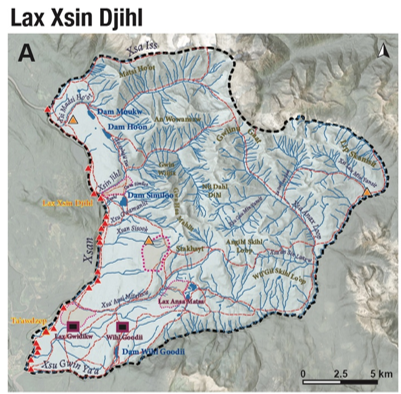
Resource extraction poses significant threats to cultural heritage sites and landscapes across British Columbia (BC, Canada), particularly in Gitxsan Territories, where people’s values are often overlooked in archaeological heritage management and consulting contexts. This research explores how Gitxsan legal orders and stewardship principles can contribute to conserving and restoring culturally and ecologically significant places—crucial work in the face of ongoing colonial policies and an increasingly changing climate. Cultural landscapes, characterized by the Lax’yip (Gitxsan Wilp/House Territories), provide a foundation for understanding long-standing stewardship practices and relationships that underscore cultural and environmental values and well-being. A key challenge, however, is how to effectively represent these landscapes to outsiders who may not share the same cultural connections to the land or understand Gitxsan heritage, histories, laws, and protocols. Reviewing these tensions in the context of resource extraction in one Territory, Lax Xsin Djihl, Wilp/House histories and stewardship practices are routinely ignored by archaeological consultants, leading to the destruction of cultural heritage. Evocative metaphors, such as cultural keystone places, may offer a way to convey the ecological and cultural realities of Territories for Gitxsan Houses, fostering a broader understanding and deeper regard for Gitxsan cultural heritage within archaeological regulatory frameworks.
References
Anderson, E. N. 1996. Ecologies of the Heart: Emotion, Belief, and the Environment. Oxford University Press, Oxford.¬¬¬
Angelbeck, B., and J. Jones. 2019. Direct Actions and Archaeology: The Lil’wat Peoples Movement to Protect Archaeological Sites. Journal of Contemporary Archaeology 5:219–229.
Armstrong, C. G. 2022. Silm Da’axk: Historical Ecology and Ethnobotany in Gitselasu Lahkhyuup. Mitchell Press, Vancouver, Canada.
Armstrong, C. G., N. Lyons, A. McAlvay, M. Ritchie, D. Lepofsky, and M. Blake. 2023a. Historical Ecology of Forest Garden Management in Ts’msyen Lahkhyuup and Beyond. Ecosystems and People 19:2160823. DOI:10.1080/26395916.2022.2160823.
Armstrong, C. G., A. Spice, M. Ridsdale, and J. R. Welch. 2023b. Liberating Trails and Travel Routes in Gitxsan and Wet’suwet’en Territories from the Tyrannies of Heritage Resource Management Regimes. American Anthropologist 125:361–376.
Armstrong, C. G., J. Grenz, J. Zyp‐Loring, J. LaFontaine, L. Main Johnson, and N. J. Turner. 2025. Ethnoecological Perspectives on Environmental Stewardship: Tenets and Basis of Reciprocity in Gitxsan and Nłeʔkepmx (Nlaka'pamux) Territories. People and Nature 7:934–946. DOI:10.1002/pan3.10641.
Bishop, E. P., and K. Shaw. 2022. The Primacy of Place: A Community’s Response to a Proposed Liquefied Natural Gas Export Facility. In Public Responses to Fossil Fuel Export, edited by H. Boudet and S. Hazboun, pp. 177–193. Elsevier, Amsterdam, Netherlands.
Black Elk, L., and J. M. Baker. 2020. From Traplines to Pipelines: Oil Sands and the Pollution of Berries and Sacred Lands from Northern Alberta to North Dakota. In Plants, People, and Places: The Roles of Ethnobotany and Ethnoecology in Indigenous Peoples’ Land Rights in Canada and Beyond, edited by N. J. Turner, pp. 173–187. McGill-Queen’s Press, Montreal, Canada.
Bonifácio, K. M., E. M. Xavier Freire, and A. Schiavetti. 2016. Cultural Keystone Species of Fauna as a Method for Assessing Conservation Priorities in a Protected Area of the Brazilian Semiarid. Biota Neotropica 16:e20140106. DOI:10.1590/1676-0611-BN-2014-0106.
Boyle, M. D., S. Soneja, L. Quirós-Alcalá, L. Dalemarre, A. R. Sapkota, T. Sangaramoorthy, S. Wilson, D. Milton, and A. Sapkota. 2017. A Pilot Study to Assess Residential Noise Exposure near Natural Gas Compressor Stations. PLOS ONE 12:e0174310. DOI:10.1371/journal.pone.0174310.
British Columbia Supreme Court. 1987. Proceedings of the Supreme Court of British Columbia 1987-05-13, 2. Trial transcript. United Reporting Service Ltd., Vancouver, BC. University of British Columbia Library Open Collections. Available at: https://doi.org/10.14288/1.0018359. Accessed on September 6, 2025.
Campbell, S., and V. Butler. 2010. Archaeological Evidence for Resilience of Pacific Northwest Salmon Populations and the Socioecological System over the Last ~7,500 Years. Ecology and Society 15:17.
Clarke, G. K. C., A. H. Jarosch, F. S. Anslow, V. Radić, and B. Menounos. 2015. Projected Deglaciation of Western Canada in the Twenty-First Century. Nature Geoscience 8:372–377. DOI:10.1038/ngeo2407.
Coe, M. A., and O. G. Gaoue. 2020. Cultural Keystone Species Revisited: Are We Asking the Right Questions? Journal of Ethnobiology and Ethnomedicine 16:70. DOI:10.1186/s13002-020-00422-z.
Cottee-Jones, H. E. W., and R. J. Whittaker. 2012. The Keystone Species Concept: A Critical Appraisal. Frontiers of Biogeography 4. DOI:10.21425/F5FBG12533.
Cuerrier, A., N. J. Turner, T. C. Gomes, A. Garibaldi, and A. Downing. 2015. Cultural Keystone-Places: Conservation and Restoration in Cultural Landscapes. Journal of Ethnobiology 35:427–448. DOI:10.2993/0278-0771-35.3.427.
Daly, R. 2005. Our Box Was Full: An Ethnography for the Delgamuukw Plaintiffs. UBC Press, Vancouver, BC.
Davic, R. D. 2003. Linking Keystone Species and Functional Groups: A New Operational Definition of the Keystone Species Concept. Conservation Ecology 7:r11.
Davis, W. 2015. The Sacred Headwaters: The Fight to Save the Stikine, Skeena, and Nass. Greystone Books Ltd, Vancouver, BC.
Dawson, N. M., B. Coolsaet, E. J. Sterling, R. Loveridge, N. D. Gross-Camp, S. Wongbusarakum, and K. K. Sangha. 2021. The Role of Indigenous Peoples and Local Communities in Effective and Equitable Conservation. Ecology and Society 26. DOI:10.5751/ES-12625-260319.
Delgamuukw v. British Columbia. 1997. 3 S.C.R. 1010 (S.C.C.). Canadian Supreme Court. Available at: https://decisions.scc-csc.ca/scc-csc/scc-csc/en/item/1569/index.do. Accessed on September 1, 2024.
Drushka, K. 1985. Stumped: The Forest Industry in Transition. Douglas and McIntyre, Vancouver, Canada.
Earnshaw, J. K. 2019. Cultural Forests in Cross Section: Clear-Cuts Reveal 1,100 Years of Bark Harvesting on Vancouver Island, British Columbia. American Antiquity 84:516–530. DOI:10.1017/aaq.2019.29.
Ellen, R. 2006. Local Knowledge and Management of Sago Palm (Metroxylon sagu Rottboell) Diversity in South Central Seram, Maluku, Eastern Indonesia. Journal of Ethnobiology 26:258–298. DOI:10.2993/0278-0771_2006_26_258_lkamos_2.0.co_2.
Estes, N. 2019. Our History Is the Future: Standing Rock Versus the Dakota Access Pipeline, and the Long Tradition of Indigenous Resistance. Verso, London, UK.
Ferris, N. 2003. Between Colonial and Indigenous Archaeologies: Legal and Extra-Legal Ownership of the Archaeological Past in North America. Canadian Journal of Archaeology / Journal Canadien d’Archéologie 27:154–190.
Francis, C. D., J. Paritsis, C. P. Ortega, and A. Cruz. 2011. Landscape Patterns of Avian Habitat Use and Nest Success Are Affected by Chronic Gas Well Compressor Noise. Landscape Ecology 26:1269–1280. DOI:10.1007/s10980-011-9609-z.
Garibaldi, A., and N. Turner. 2004. Cultural Keystone Species: Implications for Ecological Conservation and Restoration. Ecology and Society 9.
Gisday Wa, and Delgam Uukw. 1992. The Spirit of the Land: Statements of the Gitksan and Wet’suwet’en Hereditary Chiefs in the Supreme Court of British Columbia 1987-1990. Reflections, Gabriola, Canada.
Goolmeer, T., O. Costello, A. Skroblin, L. Rumpff, and B. A. Wintle. 2024. Indigenous-Led Designation and Management of Culturally Significant Species. Nature Ecology & Evolution 8:1623–1631. DOI:10.1038/s41559-024-02466-w.
Gottesfeld, A. S., and K. A. Rabnett. 2008. Skeena River Fish and Their Habitat. Oregon State University Press, Corvallis, OR.
Greer, S., and D. Strand. 2012. Cultural Landscapes, Past and Present, and the South Yukon Ice Patches. Arctic 65:136–152.
Hickey, A. 2021. An Unsuitable Integration: The Duty to Consult and Environmental Assessments in Canada. Master’s Thesis, University of New Brunswick, New Brunswick, Canada.
Horowitz, L. S. 2022. ‘Conflicts of Interests’ within and between Elite Assemblages in the Legal Production of Space: Indigenous Cultural Heritage Preservation and the Dakota Access Pipeline. The Geographical Journal 188:91–108. DOI:10.1111/geoj.12421.
Ignace, M., and R. E. Ignace. 2020. A Place Called Pípsell: An Indigenous Cultural Keystone Place, Minding, and Secwépemc Law. In Plants, People, and Places: The Roles of Ethnobotany and Ethnoecology in Indigenous Peoples’ Land Rights in Canada and Beyond, edited by N. J. Turner, pp. 131–150. McGill-Queen’s Press, Montreal.
Johnson, L. M. 2000. ‘A Place That’s Good,’ Gitksan Landscape Perception and Ethnoecology. Human Ecology 28:301–325. DOI:10.1023/A:1007076221799.
Johnson, L. M. 2010. Trail of Story, Traveller’s Path: Reflections on Ethnoecology and Landscape. Athabasca University Press, Edmonton, Canada.
Johnson, L. M. 2019. Wisdom Engaged: Traditional Knowledge for Northern Community Well-Being. Polynya Press, Edmonton, Canada.
Johnson, P. S. 2023. Centering Indigenous Approaches for a Better Cultural Resource Management: Lessons from the Dakota Access Pipeline. Transforming Anthropology 31:137–149. DOI:10.1111/traa.12256.
Joseph, L., A. Cuerrier, and D. Mathews. 2022. Shifting Narratives, Recognizing Resilience: New Anti-Oppressive and Decolonial Approaches to Ethnobotanical Research with Indigenous Communities in Canada. Botany 100:65–81. DOI:10.1139/cjb-2021-0111.
King, T. F. 2003. Places That Count: Traditional Cultural Properties in Cultural Resource Management. Rowman Altamira, Oxford.
Laluk, N. C., L. M. Montgomery, R. Tsosie, C. McCleave, R. Miron, S. R. Carroll, J. Aguilar, A. Big Wolf Thompson, P. Nelson, and J. Sunseri. 2022. Archaeology and Social Justice in Native America. American Antiquity 87:659–682. DOI:10.1017/aaq.2022.59.
Lepofsky, D. 2009. The Past, Present, and Future of Traditional Resource and Environmental Management. Journal of Ethnobiology 29:161–166. DOI:10.2993/0278-0771-29.2.161.
Lepofsky, D., C. G. Armstrong, S. Greening, J. Jackley, J. Carpenter, B. Guernsey, D. Mathews, and N. J. Turner. 2017. Historical Ecology of Cultural Keystone Places of the Northwest Coast. American Anthropologist 119:448–463. DOI:10.1111/aman.12893.
Lepofsky, D., C. G. Armstrong, D. Mathews, and S. Greening. 2020. Understanding the Past for the Future: Plants and First Nations’ Land Use and Rights. In Indigenous Peoples’ Land Rights and the Roles of Ethnoecology and Ethnobotany: Strategies for Canada’s Future, edited by N. J. Turner, pp. 86–106. McGill-Queen’s Press, Montreal.
Lepofsky, D., N. F. Smith, N. Cardinal, J. Harper, M. Morris, E. White, R. Bouchard, D. I. D. Kennedy, A. K. Salomon, M. Puckett, and K. Rowell. 2015. Ancient Shellfish Mariculture on the Northwest Coast of North America. American Antiquity 80:236–259. DOI:10.7183/0002-7316.80.2.236.
Lukawiecki, J., F. Moola, and R. Roth. 2024. Cultural Keystone Species and Their Role in Biocultural Conservation. Conservation Science and Practice 6:e13224. DOI:10.1111/csp2.13224.
McCarthy, A., C. Hepburn, N. Scott, K. Schweikert, R. Turner, and H. Moller. 2014. Local People See and Care Most? Severe Depletion of Inshore Fisheries and Its Consequences for Māori Communities in New Zealand. Aquatic Conservation: Marine and Freshwater Ecosystems 24:369–390. DOI: 10.1002/aqc.2378.
Mills, A. 1994. Eagle Down Is Our Law: Witsuwit’en Law, Feasts, and Land Claims. UBC Press, Vancouver.
Monet, D., and A. Wilson. 1992. Colonialism on Trial: Indigenous Land Rights and the Gitksan-We’Suwet’En Sovereignty Case. New Society Publishers, Gabriola, Canada.
Muir, B. R. 2022. Consequences and Implications of British Columbia’s Failed Cumulative Effects Assessment and Management Framework for Indigenous Peoples. Environmental Impact Assessment Review 95:e106764. DOI:10.1016/j.eiar.2022.106764.
Nabhan, G. P., and J. L. Carr, eds. 1994. Ironwood: An Ecological and Cultural Keystone of the Sonoran Desert. Occasional Papers in Conservation Biology, No. 1. Conservation International, Arlington County, VA.
Newell, D. 1993. Tangled Webs of History: Indians and the Law in Canada’s Pacific Coast Fisheries. University of Toronto Press, Toronto.
Nicholas, G. P. 2010. Decolonizing the Archaeological Landscape: The Practice and Politics of Archaeology in British Columbia. In Indigenous Archaeologies, edited by M. Bruchac, S. Hart, and H. M. Wobst, pp. 185–188. Routledge, New York.
Paine, R. T. 1969. A Note on Trophic Complexity and Community Stability. The American Naturalist 103:91–93. DOI:10.1086/282586.
Payne, B. F., R. Ackley, A. P. Wicker, Z. L. Hildenbrand, D. D. Carlton, and K. A. Schug. 2017. Characterization of Methane Plumes Downwind of Natural Gas Compressor Stations in Pennsylvania and New York. Science of The Total Environment 580:1214–1221. DOI:10.1016/j.scitotenv.2016.12.082.
People of ’Ksan. 1980. Gathering What the Great Nature Provided: Food Traditions of the Gitksan. Douglas and McIntyre, Vancouver.
Porter, L., and J. Barry. 2016. Planning for Coexistence?: Recognizing Indigenous Rights through Land-Use Planning in Canada and Australia. Routledge, London.
Posey, D. 1999. Cultural and Spiritual Values of Biodiversity. United Nations Environment Programme, Nairobi, Kenya.
Przelomska, N. A. S., C. G. Armstrong, and L. Kistler. 2020. Ancient Plant DNA as a Window into the Cultural Heritage and Biodiversity of Our Food System. Frontiers in Ecology and Evolution 8. DOI:10.3389/fevo.2020.00074.
Reed, K., and P. Ryan. 2019. Lessons from the Past and the Future of Food. World Archaeology 51:1–16. DOI:10.1080/00438243.2019.1610492.
Reeder-Myers, L., T. J. Braje, C. A. Hofman, E. A. Smith, C. J. Garland, M. Grone, C. S. Hadden, M. Hatch, T. Hunt, A. Kelley, M. J. LeFebvre, M. Lockman, I. McKechnie, I. J. McNiven, B. Newsom, T. Pluckhahn, G. Sanchez, M. Schwadron, K. Y. Smith, T. Smith, A. Spiess, G. Tayac, V. D. Thompson, T. Vollman, E. M. Weitzel, and T. C. Rick. 2022. Indigenous Oyster Fisheries Persisted for Millennia and Should Inform Future Management. Nature Communications 13. DOI:10.1038/s41467-022-29818-z.
Reyes-García, V., Á. Fernández-Llamazares, Y. Aumeeruddy-Thomas, P. Benyei, R. W. Bussmann, S. K. Diamond, D. García-del-Amo, S. Guadilla-Sáez, N. Hanazaki, N. Kosoy, M. Lavides, A. C. Luz, P. McElwee, V. J. Meretsky, T. Newberry, Z. Molnár, I. Ruiz-Mallén, M. Salpeteur, F. S. Wyndham, F. Zorondo-Rodriguez, and E. S. Brondizio. 2022. Recognizing Indigenous Peoples’ and Local Communities’ Rights and Agency in the Post-2020 Biodiversity Agenda. Ambio 51:84–92. DOI:10.1007/s13280-021-01561-7.
Reyes-García, V., Á. Fernández-Llamazares, P. McElwee, Z. Molnár, K. Öllerer, S. J. Wilson, and E. S. Brondizio. 2019. The Contributions of Indigenous Peoples and Local Communities to Ecological Restoration. Restoration Ecology 27:3–8. DOI:10.1111/rec.12894.
Rick, T. C., T. J. Braje, L. Graham, K. Easterday, C. A. Hofman, B. E. Holguin, A. M. Mychajliw, L. A. Reeder-Myers, and M. D. Reynolds. 2022. Cultural Keystone Places and the Chumash Landscapes of Kumqaq’, Point Conception, California. American Antiquity 87:487–504. DOI:10.1017/aaq.2021.154.
Rössler Chief, M. 2006. World Heritage Cultural Landscapes: A UNESCO Flagship Programme 1992–2006. Landscape Research 31:333–353. DOI:10.1080/01426390601004210.
Santomauro, D., C. J. Johnson, and G. Fondahl. 2012. Historical-Ecological Evaluation of the Long-Term Distribution of Woodland Caribou and Moose in Central British Columbia. Ecosphere 3. DOI:10.1890/ES11-00371.1.
Schaepe, D. M., G. Nicholas, and K. Dolata. 2020. Recommendations for Decolonizing British Columbia’s Heritage-Related Processes and Legislation. First Peoples’ Cultural Council, Brentwood Bay, Canada.
Shoghl, S. N., and G. Pazuki. 2024. Compressor/Pump Stations in Natural Gas Transmission Pipelines. In Advances in Natural Gas: Formation, Processing, and Applications. Volume 6: Natural Gas Transportation and Storage, edited by M. R. Rahimpour, M. A. Makarem, and M. Meshksar, pp. 177–236. Elsevier, Amsterdam.
Shores, C. R., N. Mikle, and T. A. Graves. 2019. Mapping a Keystone Shrub Species, Huckleberry (Vaccinium membranaceum), Using Seasonal Colour Change in the Rocky Mountains. International Journal of Remote Sensing 40:5695–5715. DOI:10.1080/01431161.2019.1580819.
Sterritt, N. 1988. Delgamuukw Trial Transcripts: Delgamuukw-Gisday Wa v. British Columbia. UBC Library Open Collections. University of British Columbia, Vancouver.
Sterritt, N. J. 2016. Mapping My Way Home: A Gitxsan History. Creekstone Press Limited, Smithers, Canada.
Sutherland-Wilson, D., A. Spice, and C. G. Armstrong. 2019. Compliance Archaeology Fails Indigenous Peoples in British Columbia: An Example from Unist’ot’en Territory. The Midden 49:26–30.
Trusler, S. 2002. Footsteps amongst the Berries: The Ecology and Fire History of Traditional Gitsxan and Wet’suwet’en Huckleberry Sites. Master’s Thesis, Athabasca University, Edmonton, Canada.
Trusler, S., and L. M. Johnson. 2008. ‘Berry Patch’ As a Kind of Place—the Ethnoecology of Black Huckleberry in Northwestern Canada. Human Ecology 36:553–568. DOI:10.1007/s10745-008-9176-3.
Turner, N. J., and K. L. Turner. 2008. ‘Where Our Women Used to Get the Food’: Cumulative Effects and Loss of Ethnobotanical Knowledge and Practice; Case Study from Coastal British Columbia. Botany 86:103–115. DOI:10.1139/B07-020.
Wolverton, S., R. M. Figueroa, and C. G. Armstrong. 2023. Integrating Historical Ecology and Environmental Justice. Journal of Ethnobiology 43:57–68. DOI:10.1177/02780771231162196.
Wyndham, F. S. 2017. The Trouble with TEK. Ethnobiology Letters 8:78–80. DOI:10.14237/ebl.8.1.2017.1006.
Copyright (c) 2025 Ardythe Wilson Dimdiigibuu, Chelsey Geralda Armstrong

This work is licensed under a Creative Commons Attribution-NonCommercial 4.0 International License.
Authors who publish with this journal agree to the following terms:
- Authors retain ownership of the copyright for their content and grant Ethnobiology Letters (the “Journal”) and the Society of Ethnobiology right of first publication. Authors and the Journal agree that Ethnobiology Letters will publish the article under the terms of the Creative Commons Attribution-NonCommercial 4.0 International Public License (CC BY-NC 4.0), which permits others to use, distribute, and reproduce the work non-commercially, provided the work's authorship and initial publication in this journal are properly cited.
- Authors are able to enter into separate, additional contractual arrangements for the non-exclusive distribution of the journal's published version of the work (e.g., post it to an institutional repository or publish it in a book), with an acknowledgement of its initial publication in this journal.
For any reuse or redistribution of a work, users must make clear the terms of the Creative Commons Attribution-NonCommercial 4.0 International Public License (CC BY-NC 4.0).
In publishing with Ethnobiology Letters corresponding authors certify that they are authorized by their co-authors to enter into these arrangements. They warrant, on behalf of themselves and their co-authors, that the content is original, has not been formally published, is not under consideration, and does not infringe any existing copyright or any other third party rights. They further warrant that the material contains no matter that is scandalous, obscene, libelous, or otherwise contrary to the law.
Corresponding authors will be given an opportunity to read and correct edited proofs, but if they fail to return such corrections by the date set by the editors, production and publication may proceed without the authors’ approval of the edited proofs.


